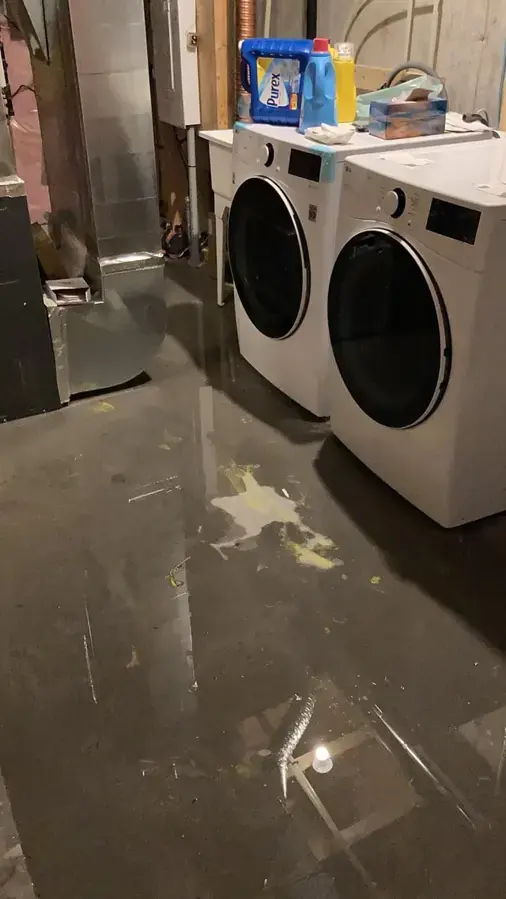
First steps for appliance and water softener leaks in Dayton
- 1
Close the appliance valve
Turn off the valve behind the machine or under the sink, and unplug the appliance only if the outlet is dry.
- 2
Pull the appliance out
If it can be moved safely, slide it away from the wall to expose the hose, the seal and the floor beneath.
- 3
Soak up the surface
Blot standing water with towels and lift small rugs, but leave wet cabinets and flooring in place for readings.
- 4
Photograph the leak
Photograph the appliance, the hose or seal, the wet floor and any stains below, and keep the failed part.
Appliance leaks are quieter than burst pipes, and that is the problem. A washer hose weeps behind the machine, a dishwasher seal drips into the cabinet base or a softener drain spills onto the floor, and the damage builds for days before a stain or a smell gives it away.
What does appliance and water softener leaks cost in Dayton, MN?
Appliance leak cleanup in Dayton usually runs $800 to $1,800 for a fresh leak on a hard floor and $1,800 to $5,000 under cabinets or floors, with slow leaks or leaks across two levels starting at $5,000.
Fresh leak, hard floor
$800 to $1,800
- Water on tile or concrete
- Extraction and light drying
- Clean or gray water
Under cabinets or floors
$1,800 to $5,000
- Cabinet bases and subfloor wet
- Toe kicks off, cavity drying
- Flooring checked first
Two levels or slow leak
$5,000 and up
- Ceiling below soaked too
- Cabinets or flooring replaced
- Extended drying
Ranges are typical, not a quote: the water category, square footage, material class and how fast drying started move the number most. Run the water damage cost calculator for a closer range.
Where appliance water hides
Appliances sit against walls and cabinets, so water often disappears into places a mop cannot reach.
- Cabinet bases and toe kicks under kitchen sinks and dishwashers
- Subfloor and flooring under a washer or refrigerator
- Drywall behind a laundry hookup or a softener drain
- The ceiling or wall of the space below
Drying starts with removing the toe kicks and checking cabinet bases, because trapped moisture there can soak particleboard that does not recover. Solid wood and sealed surfaces fare better, and readings sort out which is which.
Apartments and shared floors
Dayton has apartment housing, including a 49-unit workforce building in the mixed-use area of Northeast Dayton, completed in 2017, and the city lists a 176-unit apartment project called Arbor Ridge Parkway, formerly The Parkway Neighborhood. In an apartment building, floors are shared, so a leak in one unit can reach the one below.
The drying team maps both spaces and keeps separate records for each, so the tenant, the owner and the insurers each get a clear file. A single-family home faces the same leak with a different path, usually down into a basement.
Spotting leaks early
The city offers a web portal that sends alerts about potential leaks or unusual water use, and an appliance supply that keeps running can trigger one. Households on private wells will not see an alert, so a damp floor or swollen trim is the first clue.
Warping laminate, a soft spot in vinyl and a damp cabinet are all worth a look, and a quick check behind the washer every few months catches a weeping hose before it fails.
What happens at the property
The crew shuts off the supply, extracts standing water, removes toe kicks and baseboards and dries cabinets and flooring in place where readings allow.
If the water reached the ceiling below, water extraction and structural drying widen to both levels, and photos and logs cover each space.