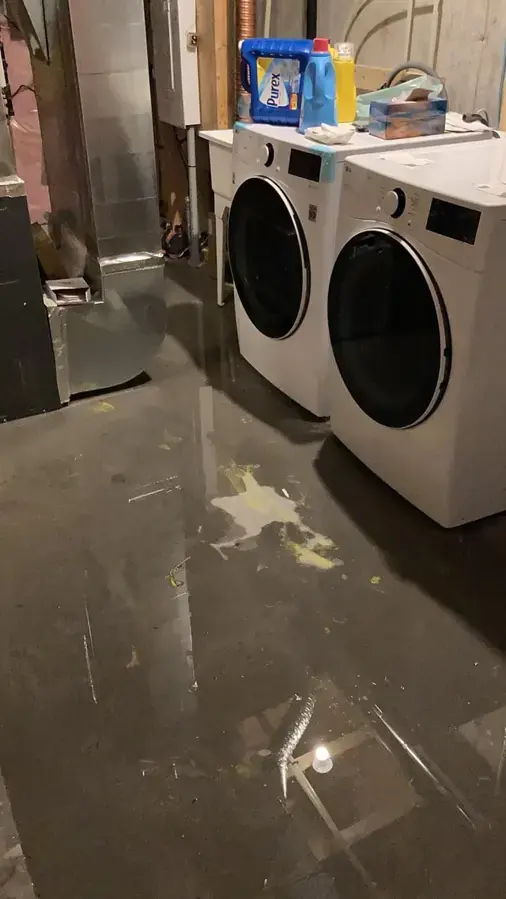
First steps for appliance and water softener leaks in Champlin
- 1
Shut the supply valve
Close the small valve behind the washer, under the dishwasher or at the softener, then unplug the appliance if the floor is dry.
- 2
Soak up the surface
Mop and towel what you can, then open cabinet doors and lift rugs so air reaches the wet edges.
- 3
Check the floors below
Look at the basement ceiling or the unit underneath for stains, bubbling paint or drips, and switch off power to any wet fixture.
- 4
Capture it all
Photograph the appliance, the hose, the floor and every damaged item, then call before anything is thrown away.
Most appliance leaks are small until they are not. A cracked washer hose, a dishwasher door seal or a water softener drain hose can run for hours or weeks, and the water often leaves the room before anyone sees it.
What does appliance and water softener leaks cost in Champlin, MN?
Appliance and water softener leak cleanup in Champlin usually costs $800 to $1,800 for a fresh leak on a hard floor, $1,800 to $5,000 under cabinets or floors, and $5,000 and up for two levels or a slow leak.
Fresh leak, hard floor
$800 to $1,800
- Water on tile or vinyl
- Extraction, then fast drying
- Clean or gray water
Under cabinets or floors
$1,800 to $5,000
- Cabinet bases and subfloor wet
- Toe kicks off, cavity drying
- Flooring checked before cuts
Two levels or slow leak
$5,000 and up
- Ceiling below soaked too
- Cabinets or flooring replaced
- Extended drying and checks
Ranges are typical, not a quote: the water category, square footage, material class and how fast drying started move the number most. Run the water damage cost calculator for a closer range.
Common appliance and softener leak sources
Four household sources cause most appliance losses. The water softener is easy to forget because it sits quietly in the corner of a utility room until a drain hose slips or the brine tank overfills.
- Washing machine supply hoses that bulge or crack
- Dishwasher inlet fittings and door seals
- Refrigerator ice-maker supply tubes
- Water softener drain hoses and brine tanks
The city's 2026 fee schedule lists plumbing fees for fixtures, water softeners and sumps, so the plumber who replaces a failed unit can confirm what applies.
Shared walls in townhomes and apartments
In 2016 the city counted 1,186 townhomes and 685 apartment units, and condominium developments such as Emery Village add more shared walls. A failed hose in one unit can reach the unit below or next door through the same wall and ceiling cavity.
That makes the first step documentation. Each affected unit needs photos, moisture readings and a written note, and the association or landlord should hear about the leak early so every owner's claim stands on its own.
What hides under cabinets and flooring
Water from an appliance runs under toe kicks, behind cabinet bases and into the subfloor seam. Vinyl, laminate and hardwood can look fine on top while the layer below stays wet, so surface checks are never enough.
The tech who does the walkthrough reads moisture at the cabinet bases, flooring seams and the ceiling below. Toe kicks come off to let air in, and flooring is lifted only where readings stay high.
Drying after the appliance is fixed
Extraction comes first on hard floors, followed by weighted extraction on carpet. Then air movers and a dehumidifier run until cabinet bases and subfloor read dry.
A hose that fails under pressure acts like a small Champlin burst pipe, and a failing tank follows the steps for water heater leak cleanup in Champlin.