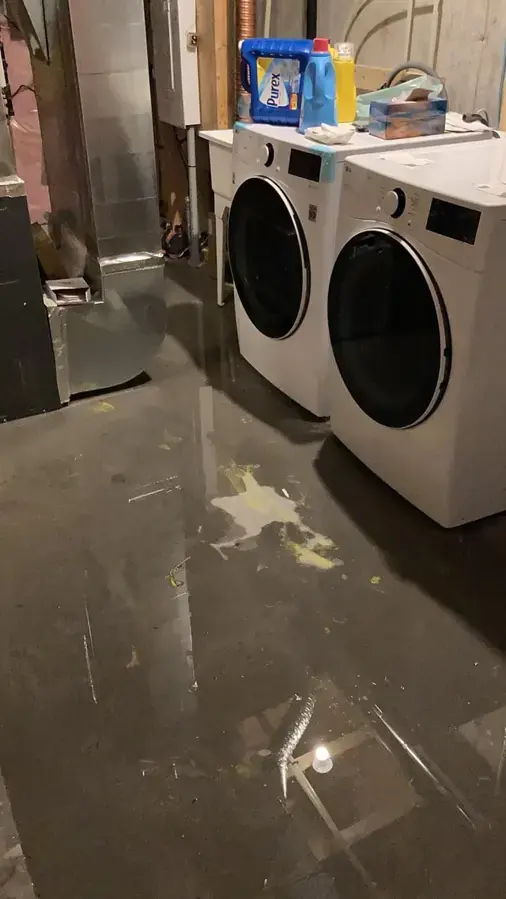
First steps for appliance and water softener leaks in Coon Rapids
- 1
Shut the supply
Close the shutoff valve behind the appliance or the main water valve, then unplug the appliance only if the floor around it is dry.
- 2
Mop up the surface
Soak up standing water with towels, and pull the appliance out only if it can be moved without wading through water.
- 3
Check the room below
Look at the ceiling and walls under the leak for stains or drips, and photograph them with the appliance and the water.
- 4
Call for readings
The drying team maps the wet cabinet bases, flooring and subfloor and decides what to open.
Most appliance leaks are small until they are not. A washer hose that bursts, a dishwasher that overflows, a refrigerator supply tube that drips or a water softener that leaks can soak a floor, run under cabinets and reach the ceiling of the room below.
What does appliance and water softener leaks cost in Coon Rapids, MN?
Expect $800 to $1,800 when a leak is caught on a hard floor, $1,800 to $5,000 once water gets under cabinets or into the subfloor, and $5,000 and up for a second level or a slow leak.
Recent leak on a hard floor
$800 to $1,800
- Spill across tile, vinyl or slab
- Extraction and fast drying
- Clean or gray water
Water beneath cabinets or flooring
$1,800 to $5,000
- Wet cabinet bases and subfloor
- Toe kicks off, cavities dried
- Flooring readings taken first
Second level or slow leak
$5,000 and up
- Ceiling below soaked as well
- Cabinets or flooring replaced
- Longer drying run
Ranges are typical, not a quote: the water category, square footage, material class and how fast drying started move the number most. Run the water damage cost calculator for a closer range.
Why one unit's leak reaches neighbors
The city's 2040 plan counted 4,367 attached townhome units and 4,369 multi-family units in 2015, alongside 15,670 single-family detached homes. In an attached building, a failed washer hose or softener can send water into the wall, floor or ceiling of the unit next to it.
That is why the first call matters in a multi-unit building: the neighbor's ceiling, the shared wall and the unit below all need readings, not just the room with the broken appliance.
Hidden water under cabinets and floors
Water from a dishwasher or refrigerator tube runs along the floor and gets under toe kicks, into cabinet bases and down through subfloor seams, where it stays long after the surface looks dry.
- Toe kicks and cabinet bases that wick water upward
- Laminate and vinyl planks that swell at the seams
- Subfloor and bottom plates under the appliance
- Drywall behind the washer, dryer or softener
A moisture meter and thermal camera find the wet cavity first, and toe kicks come off so air movers can dry the space behind them.
Slow leaks and softener brine
A slow leak at a hose connection or a softener drain can run for weeks. The damage shows up as a soft floor, a musty smell, a swollen cabinet base or a stain on the ceiling below, and the readings usually show a wider wet area than the visible stain.
Dishwasher and refrigerator leaks are usually small drips at first. The danger is time, because a quiet drip under a cabinet keeps a subfloor wet for as long as it runs.
Cleanup and drying
Extractors take the standing water, wet cabinet bases and toe kicks are opened or removed, and air movers and a dehumidifier dry the floor and cavities. Water from a washer or dishwasher is treated as gray, while a clean supply leak stays Category 1.
If the water reached a lower level, water extraction in Coon Rapids and structural drying run on both floors.