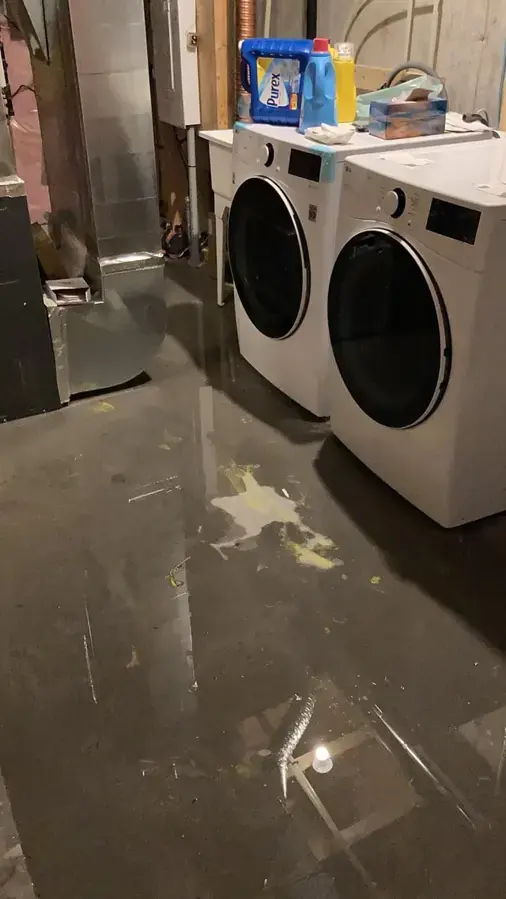
First steps for appliance and water softener leaks in Ramsey
- 1
Stop the appliance
Switch off the machine, close its supply valve and pull it away from the wall only if the floor around it is dry and safe.
- 2
Mop and open up
Soak up standing water, open cabinet doors and toe kicks, and run a fan so air reaches wet surfaces.
- 3
Check below and beside
Look at the ceiling below and the wall beside the appliance for stains, and tell any neighbor sharing a wall.
- 4
Photograph and call
Photograph the leak point and the wet areas, then call the drying team for extraction and meter readings.
Most appliance leaks are slow ones. A cracked supply hose behind a washer or a softener drain that no longer seats can drip into a cabinet base or a basement ceiling for weeks, and the damage shows up as a soft floor or a stain on the level below.
What does appliance and water softener leaks cost in Ramsey, MN?
A fresh leak on a hard floor costs between $800 and $1,800. Water under cabinets or flooring runs $1,800 through $5,000, and a slow leak or one that reached the level below starts at $5,000.
Hard floor, caught fresh
$800 to $1,800
- Tile, vinyl or sealed concrete
- Water pulled out, fans set
- Clean or gray water
Cabinets or flooring wet
$1,800 to $5,000
- Cabinet base and subfloor damp
- Toe kicks removed to dry
- Meter checks before replacement
Slow leak or second level
$5,000 and up
- Ceiling below also soaked
- Cabinets or floors replaced
- Longer drying schedule
Ranges are typical, not a quote: the water category, square footage, material class and how fast drying started move the number most. Run the water damage cost calculator for a closer range.
Common sources and what they leave
Water from supply hoses and ice makers is clean to start with, while dishwasher and washer discharge is gray water that carries soap and food or lint residue. The category sets how much material has to be removed.
- Washer hoses that crack or loosen at the fitting
- Dishwasher hookups and door seals that drip under the cabinet
- Refrigerator ice maker supply tubing
- Water softener drains, brine tanks and connections
Shared walls and neighboring units
Ramsey has an estimated 1,929 attached homes such as townhomes and 740 homes in buildings of 50 or more units, plus 147 in buildings of 20 to 49 units. In those buildings a leak can pass through a floor or a shared wall into someone else's home.
When that happens the drying team maps each affected unit, documents it separately and lets owners and managers see the same readings, which keeps responsibility questions factual instead of guesswork.
Permits and water softeners
Ramsey's list of work that needs a city permit includes water softeners and plumbing alterations. A leaking softener may need new fittings or a replacement, so owners should ask the city about permits while the drying team handles the water that escaped.
Drying cabinets and floors
Toe kicks come off first so air can reach the cabinet base, and the tech checks the subfloor, the flooring and the baseboard with a meter before deciding what stays. Laminate and engineered floors that cup are often replaced; tile and vinyl over a dry subfloor usually survive.
Records for the claim include photos of the appliance and the leak point, the repair invoice and a daily moisture log. For larger losses see water extraction, and for the heater side see water heater leak cleanup.