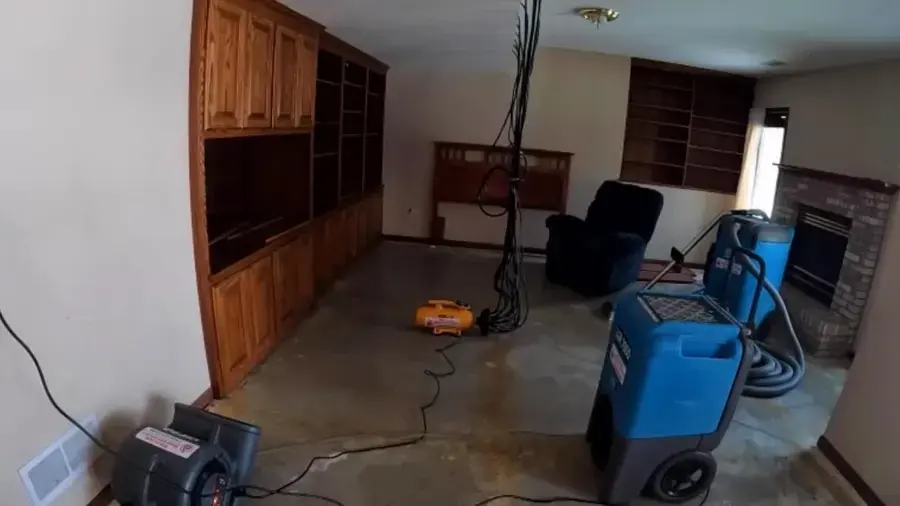
First steps for structural drying and dehumidification in Dayton
- 1
Keep the space closed
Close doors and windows in the affected area so the dehumidifiers work on the room, not the outdoors.
- 2
Leave equipment running
Do not turn off or move air movers and dehumidifiers, which run continuously until the tech confirms dry readings.
- 3
Clear the airflow
Move stacked boxes and furniture away from walls so air reaches wet surfaces, and keep pets away from the equipment.
- 4
Keep the logs together
Keep the tech's daily log and the photos in one place so the insurer can follow the drying from start to finish.
Structural drying is where most of the damage control happens. Once extraction ends, water is still locked in framing, subfloor, drywall and insulation, and it leaves only if the air around it is warm and dry. The drying team builds that environment room by room and measures it until the building agrees.
What does structural drying and dehumidification cost in Dayton, MN?
Structural drying in Dayton usually runs $1,000 to $2,500 for one or two rooms and $2,500 to $6,000 for a basement or one floor, with dense materials such as hardwood, plaster or concrete starting at $6,000 and running longer.
One or two rooms
$1,000 to $2,500
- Smaller, lower-class loss
- Few air movers, one dehumidifier
- Often three to four days
Basement or one floor
$2,500 to $6,000
- Larger, higher-class loss
- Several LGR dehumidifiers in place
- Daily psychrometric logs
Dense materials
$6,000 and up
- Hardwood, plaster or concrete
- Desiccant or specialty drying
- Longer equipment runs expected
Ranges are typical, not a quote: the water category, square footage, material class and how fast drying started move the number most. Run the water damage cost calculator for a closer range.
How the equipment works together
Drying is a system, and the pieces are matched to the size and class of the loss.
- Air movers push dry air across wet surfaces to lift moisture off them
- LGR dehumidifiers pull that moisture out of the air and drain it away
- Desiccant units handle cold or very damp spaces and dense materials
- Meters and a thermal camera show where moisture is hiding
The tech who does the walkthrough sets the equipment, closes the space off from outside air and returns to check the numbers. Equipment is moved or added as readings change, so the setup on day three is rarely the setup on day one.
Readings, not guesses
The IICRC S500 standard asks for measurement: temperature, relative humidity and the moisture content of the materials, taken on a schedule and compared with a dry reference. Daily psychrometric logs show whether the drying is on track.
Drying is complete when materials read like the dry reference points in the same building, not when they feel dry. The logs then go into the claim file.
Dayton buildings, old and new
Dayton has 899 homes built in 2010 or later, 551 from the 1970s and 175 from 1949 or earlier, and denser materials such as hardwood, plaster or concrete can take longer to dry. The team checks what is actually behind the surface before choosing equipment.
New construction is going up in Brayburn Trails East, DCM Farms, Legacy Woods, Riverwalk and Territorial Grove. Tighter construction can hold humidity in, so equipment runs inside a closed space and the air is managed with care.
After the equipment leaves
Final readings, photos and logs are bundled for the owner and insurer, and remaining repairs can begin on dry framing.
Drying follows extraction in every loss type, including basement flooding cleanup and water extraction, and the logs are what separate a dry building from one that only looks dry.