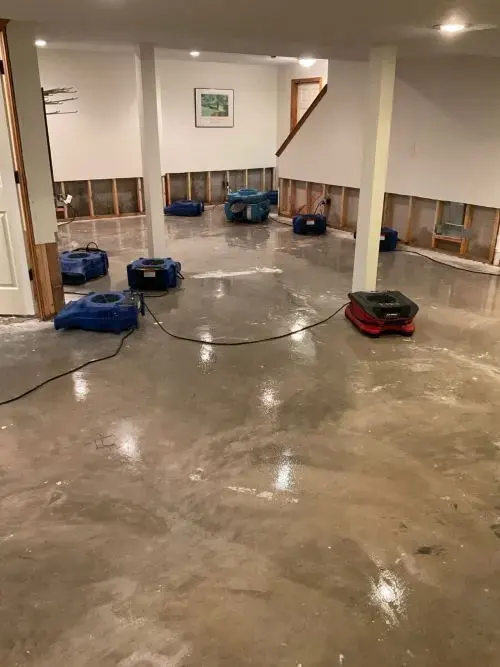
First steps for basement flooding cleanup in Dayton
- 1
Find the water source
Look for a stalled sump pump, a rising pit, water at the floor drain or a wet wall. Shut the main valve if a pipe is feeding the flood.
- 2
Keep power away from water
Stay out of a flooded basement while outlets, cords or the panel are underwater, and have the power cut from a dry location before anyone goes down.
- 3
Save what is dry
Carry boxes, electronics and papers upstairs, set furniture on blocks and take photos of the waterline, the pump and the damaged contents.
- 4
Skip the household vacuum
A household vacuum cannot move deep water and is a shock risk near it. Wait for pumps and extractors rather than spreading the mess.
Dayton basements take on water from more than one source: a pit that overflows, soil that cannot drain, a floor drain that backs up or a pipe that lets go upstairs. The response team finds the source, pumps out the standing water, then sorts what can dry in place from what has to come out, so the slab, the block walls and the framing get a fair chance to dry.
What does basement flooding cleanup cost in Dayton, MN?
Dayton basement cleanups usually run $1,500 to $3,500 for an unfinished space and $3,500 to $8,500 once carpet and drywall are wet, while sewage or river water starts at $8,500 and climbs with the size of the loss.
Unfinished basement
$1,500 to $3,500
- Bare slab and block walls
- Pump-out, extraction, drying
- Clean water or groundwater
Finished basement
$3,500 to $8,500
- Carpet, pad and lower drywall
- Flood cuts and framing drying
- Clean or gray water
Contaminated basement
$8,500 and up
- Sewer backup or river water
- Containment and full removal
- Disinfectant, then drying
Ranges are typical, not a quote: the water category, square footage, material class and how fast drying started move the number most. Run the water damage cost calculator for a closer range.
How water reaches a Dayton basement
The city's own code points to the problem: its sump ordinance covers buildings that need a discharge system because water infiltrates basements, crawl spaces and similar low areas. That wording describes the everyday Dayton basement, where wet soil is the usual suspect and the pump is the main safeguard.
- Groundwater seeping through floor cracks and wall joints after heavy rain or spring runoff
- A sump pit that fills faster than the pump can empty it, or a pump that loses power
- A floor drain that backs up, which can bring sewer water into the picture and changes the cleanup
- River high water on low ground, which is cleaned up as flood water rather than a simple pump-out
Poorly drained low spots with wetland plants are common across Dayton, so ground that stays saturated after a storm keeps pressing on basement walls and slabs. Once the pit overflows or the pump quits, that pressure shows up as water on the floor.
What comes out and what stays to dry
Concrete floors and block walls dry in place. Carpet and pad from clean water caught early can sometimes be lifted, dried and reset, but gray water or sewage sends them out for disposal. Drywall that wicked water upward is cut at a level above the wet edge, and soaked insulation behind it is removed too. Wood trim and baseboard are pulled and labeled so they can go back if they dry clean.
Finished basements take longest, since trim, plates and lower drywall hold moisture after the surface looks dry. The tech who does the walkthrough follows the wet material up the wall with a moisture meter and thermal camera, so each opening matches the damage and goes no further.
Old basements and new ones
Dayton housing runs from 175 homes built in 1949 or earlier and 551 from the 1970s to 899 built in 2010 or later. An older block-wall basement may seep at the joints, while a newer one depends on a sump system that has to keep working. Both start the same way: stop the water, then dry.
New neighborhoods such as Riverwalk, Territorial Grove and Legacy Woods are still being built, and the Historic Village sits where the two rivers meet, so the same crew sees brand new subdivisions and the oldest blocks in town. That mix means equipment for tight block basements as well as open, newer finished floors.
When the basement reads dry
Drying ends when readings match a dry reference, not when the calendar says so. The team logs temperature, humidity and moisture content at each visit, then pulls the equipment and hands over the records. Photos of the final readings sit in the file beside the first ones, which shows the insurer the full arc of the loss.
Related work often follows: structural drying for the framing, sump pump failure cleanup when the pit caused it, and sewage backup cleanup when a drain was involved.