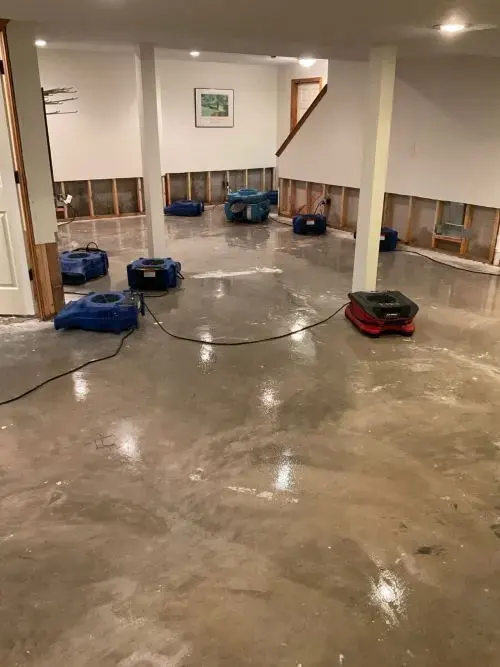
First steps for basement flooding cleanup in Champlin
- 1
Shut off the source
For a leaking pipe or tank, close the main valve. For an overflowing sump pit, confirm the pump is plugged in and the float switch is not stuck.
- 2
Report a sewer backup
If sewage came up the floor drain, stop running water in the house and report it to the Champlin Utilities Department, or Hennepin County Dispatch after hours.
- 3
Keep away from wet power
Stay out of water that touches outlets, cords or the furnace, and leave the electrical panel alone if it sits in the wet area.
- 4
Photograph the high mark
Take pictures of the waterline on each wall, the source and any wet storage boxes before cleanup begins. Those marks help set the flood cut height.
Champlin sits on the Mississippi River, and the Hennepin County Soil Survey lists high ground water levels as a building limit in several parts of the city. When a Champlin basement floods, the water usually comes from saturated ground, an overwhelmed sump pit, a floor drain backup or a failed pipe or appliance one floor up, and each of those gets a different cleanup.
What does basement flooding cleanup cost in Champlin, MN?
Champlin basement cleanups typically cost $1,500 to $8,500. Clean water on bare concrete stays near the bottom of that range, while a remodeled lower level or any sewer backup pushes the total higher.
Unfinished basement
$1,500 to $3,500
- Bare concrete and block walls
- Pump-out, extraction, drying
- Clean water or ground water
Finished lower level
$3,500 to $8,500
- Carpet, pad and lower drywall
- Flood cuts and slab drying
- Clean or gray water
Sewer or creek water
$8,500 and up
- Category 3 contamination
- Containment and full removal
- Antimicrobial, then drying
Ranges are typical, not a quote: the water category, square footage, material class and how fast drying started move the number most. Run the water damage cost calculator for a closer range.
Where Champlin basement water comes from
Before any drying equipment goes in, the restoration crew pins down the source, because it decides the water category and the cleanup:
- Ground water forced in at the floor and walls when the soil stays saturated
- An overflowing sump pit after a pump failure, a power outage or more inflow than the pump can move
- Sewage rising through the floor drain when the sewer is running full
- A failed supply pipe, water heater or washer hose on the floor above
Champlin's sewer plan lists sump pumps and foundation drains among the ways clearwater gets into the sanitary sewer, so the pit and its discharge get checked along with the floor. A pit that overflowed follows the sump pump failure cleanup plan once the floor is clear.
Lower levels in homes built from the 1960s on
The city housing plan says over 70 percent of Champlin housing was built after 1980, while many apartment units date to the 1960s and 1970s and homes from 1960 to 1980 are going through renovation. A remodeled lower level hides several layers that hold water: carpet and pad, drywall, insulation and the wooden plates at the bottom of each wall.
The restoration team judges each layer by the category and the time it stayed wet. When clean water is extracted quickly, carpet and some drywall can often stay in place. Gray water means the pad goes and the drywall is cut a little above the wettest reading. Sewage, creek water or river water means every porous layer it reached comes out.
Sewer backups and the Champlin system
Champlin's sewage, apart from one area, flows through the CAB Interceptor to the Metropolitan Wastewater Treatment Plant in St. Paul. The city lines vitrified clay sewer pipe through a rehabilitation program, and from December 2024 to February 2025 it had parts of the public main lined with cured-in-place pipe, which helps keep ground water out of the sewer.
For a basement sewer backup, the city asks residents to call its Utilities Department on weekdays and Hennepin County Dispatch after hours. The mitigation team handles what is left in the basement: containment, removal, an EPA-registered antimicrobial and drying, the same order laid out on the sewage backup cleanup page.
Drying the slab and walls
Concrete poured against cool, damp ground releases water slowly. The drying team runs LGR dehumidifiers beside the fans, keeps doors and windows shut and takes readings on the floor, the walls and the wall plates each morning.
The fans and dehumidifiers stay until every material reads close to an unaffected reference, within 2 to 4 points, the target explained on the structural drying page. Each reading and photo is added to the claim file.