First steps for basement flooding cleanup in Coon Rapids
- 1
Stop and stay safe
Shut off the source if there is one, switch off power to wet areas from a dry spot and keep everyone out of standing water, especially if sewage may be involved.
- 2
Document before moving
Photograph the water level, the source and damaged belongings, and note when the water was found. Lift small items onto dry surfaces afterward.
- 3
Call for pump-out
Dispatch is staffed around the clock. Describe the water, its source and the rooms affected so pumps, extractors and dehumidifiers can be loaded for the job.
- 4
Let the crew sort it
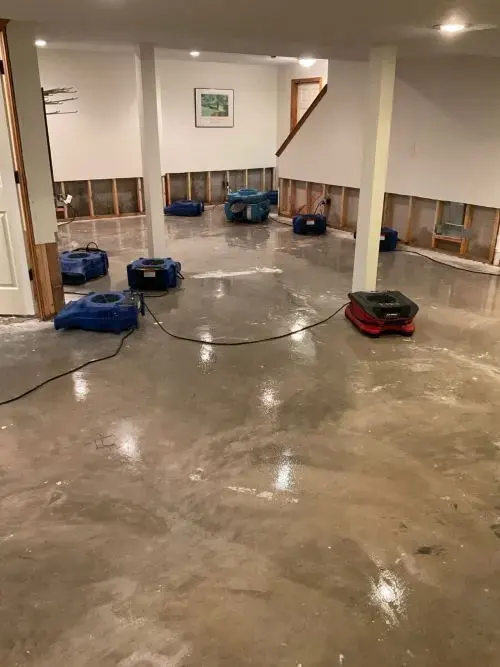
The team removes standing water, separates what can dry from what must go and starts the drying equipment, with readings logged each day.
A flooded basement in Coon Rapids is rarely a single problem. Ground water, a sump pit that quit, a floor drain that backed up or a failed appliance can each leave water on the slab, and each source changes what has to be removed. The response team finds the source, stops what can be stopped and pumps the standing water out before anything else.
What does basement flooding cleanup cost in Coon Rapids, MN?
Basement flooding in Coon Rapids usually costs $1,500 to $3,500 for an unfinished space, $3,500 to $8,500 once carpet, pad and drywall are involved, and $8,500 and up when sewage or river water is in the mix.
Bare concrete basement
$1,500 to $3,500
- Slab and block walls only
- Pump-out, extraction and drying
- Clean or ground water
Finished, carpet and drywall
$3,500 to $8,500
- Carpet, pad and lower drywall out
- Flood cuts, then structural drying
- Clean or gray water
Sewage or river water
$8,500 and up
- Contaminated Category 3 water
- Containment and complete tear-out
- Antimicrobial pass before drying
Ranges are typical, not a quote: the water category, square footage, material class and how fast drying started move the number most. Run the water damage cost calculator for a closer range.
What the sand plain means for a wet basement
The Coon Creek Watershed District places its watershed in the Anoka Sand Plain, flat land with historically high water tables, and local news describes Coon Rapids soil as sandy. Ground water can sit against a foundation in that setting and work through floor cracks and wall joints.
- Sump pit overflow when the pump fails or cannot keep up
- Seepage at floor cracks and the joint where slab meets wall
- A floor drain that backs up when a private sewer pipe clogs
- A failed water heater, softener or washer hose in the utility area
Naming the source early matters because it sets the water category, and the category decides how much material has to come out.
The watershed district also says about one half of the Coon Creek watershed is flood prone, so a basement near a creek or drainageway deserves a closer look after any big melt or storm.
Ramblers, split-entries and multi-levels
The city describes Coon Rapids housing as single family homes, twinhomes, townhomes, apartments and senior living units, in styles from one-level ramblers to split-entries and multi-levels. In any of them, the lowest finished level is where water ends up, and carpet, pad and bottom drywall take it on first.
Officials discussing sewer pipes at a City Council meeting said, according to MinneapoliMedia, that sewer backups can damage basements and lower level living spaces, including flooring, walls and appliances. A backup is handled as contaminated water, so it follows the sewage backup cleanup process in Coon Rapids.
How the pump-out and tear-out are sequenced
Submersible pumps clear deep water first, then truck-mounted and weighted extractors pull moisture out of carpet and pad. Clean-water carpet over concrete is sometimes lifted and dried in place. Gray water or sewage means the carpet and pad are removed.
Drywall is probed with a moisture meter. Flood cuts go in a set height above the water mark, and only where the readings show wet insulation or wet bottom plates. Furniture and boxes are moved onto blocks or into a dry room so they stay out of the wet zone.
Drying and the paperwork
Air movers push dry air across the slab and walls while LGR dehumidifiers pull moisture out of the room. The drying team reads the same points every day and moves equipment as each area reaches its goal.
A bare concrete basement can finish drying in a few days. A finished one with wet bottom plates, insulation and subfloor runs longer, and the readings, not the calendar, decide when the equipment leaves.
Dated photos, a moisture map and the daily log go into the claim file. If the water came from a failed pump, sump pump failure cleanup in Coon Rapids also looks at the pit and the discharge.