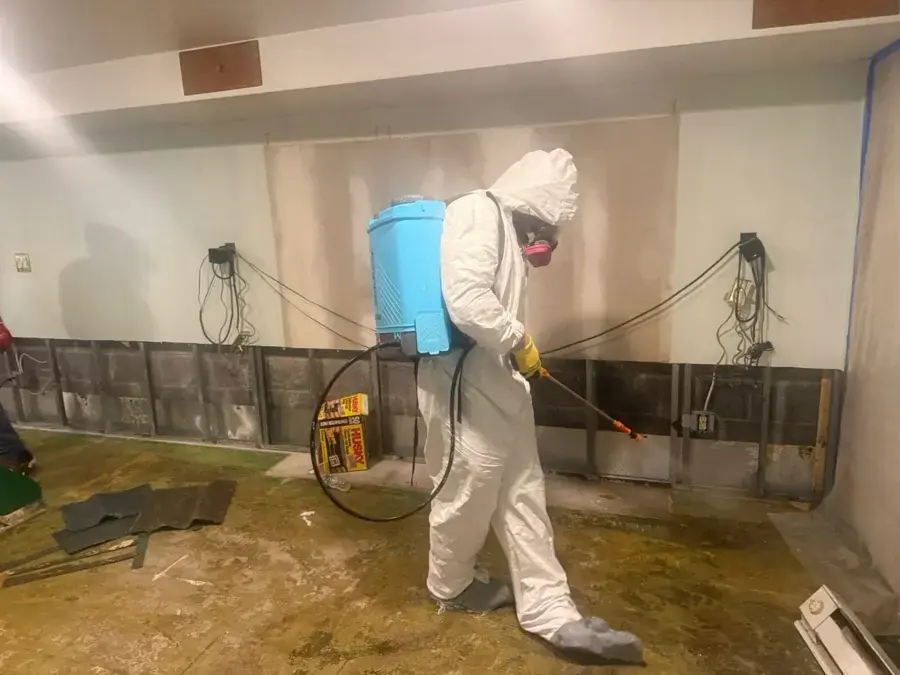
First steps for sewage backup cleanup in Coon Rapids
- 1
Leave the area
Keep people and pets out of the room, close the door and do not run a household vacuum or fan through sewage.
- 2
Stop the flow
Stop using toilets, sinks, showers, the washer and the dishwasher until the blockage is found and cleared.
- 3
Photograph from the doorway
Take photos from outside the wet area, note when the backup started and keep any plumber's report for the file.
- 4
Call for containment
Describe what came up and where. The team brings protective gear, extractors, containment materials and an air scrubber.
A sewage backup is a health problem as well as a water problem. The water carries bacteria, so carpet, pad, drywall and anything else porous that it touched comes out, and the area is contained before a single air mover runs.
The first call often comes from someone staring at a floor drain or a toilet and wondering whether the water is safe to touch. It is not, and the right first move is to step back and keep everyone else out too.
What does sewage backup cleanup cost in Coon Rapids, MN?
A small backup on bare concrete runs $2,500 to $4,500 in Coon Rapids. A finished basement with carpet and drywall to remove runs $4,500 to $12,000, and a large or repeat backup starts at $12,000.
Small backup, concrete floor
$2,500 to $4,500
- Backup at the floor drain
- Removal, disinfection, drying
- Few porous materials
Finished lower level
$4,500 to $12,000
- Carpet, pad and drywall pulled out
- Containment with HEPA scrubbing
- Antimicrobial, then drying
Big or recurring backup
$12,000 and up
- Water spread across the level
- Contents sorted, full tear-out
- Longer drying and more checks
Ranges are typical, not a quote: the water category, square footage, material class and how fast drying started move the number most. Run the water damage cost calculator for a closer range.
Northdale and the older private pipes
The Northdale Addition was largely developed in the late 1960s and early 1970s, when clay and early concrete sewer pipes were commonly installed, according to MinneapoliMedia. At a City Council meeting on December 16, 2025, officials said closed circuit television inspections show the public mains are structurally sound while private service pipes are often in far worse condition.
In the same coverage, officials tied the disruptions mainly to root intrusions and blockages in private service connections, not to failures in city mains, and added that a backup can ruin flooring, walls and appliances on a lower level.
What the cleanup includes
- Protective suits, gloves and respirators for everyone in the work area
- Plastic containment and an air scrubber with HEPA filtration
- Removal of carpet, pad, drywall and insulation the water reached
- Antimicrobial treatment of the slab, framing and every surface that stays
Hard surfaces and framing are cleaned and treated before drying starts, because drying over contamination only warms it up.
Contents are sorted as well. Hard items can be cleaned and disinfected, while upholstered and paper items that touched sewage are usually discarded.
Where the wastewater goes
All wastewater from Coon Rapids flows through Council interceptors to the Metropolitan Wastewater Treatment Plant in St. Paul, and Metropolitan Council Environmental Services provides the treatment. The city's Utilities Division operates and maintains the sanitary sewer system, including 16 lift stations that serve small isolated areas.
Whatever caused the backup, the work inside the house is the same: contain, remove, disinfect and dry.
Why drying comes last
Once the area has been cleaned, air movers and LGR dehumidifiers dry the slab and remaining framing. Readings confirm the structure is dry before anything is rebuilt, and the photos, maps and logs go into the claim file.
Sewer water and river flood water are both Category 3, so river and spring flood cleanup in Coon Rapids follows the same containment and removal rules. Drying then follows the structural drying plan.