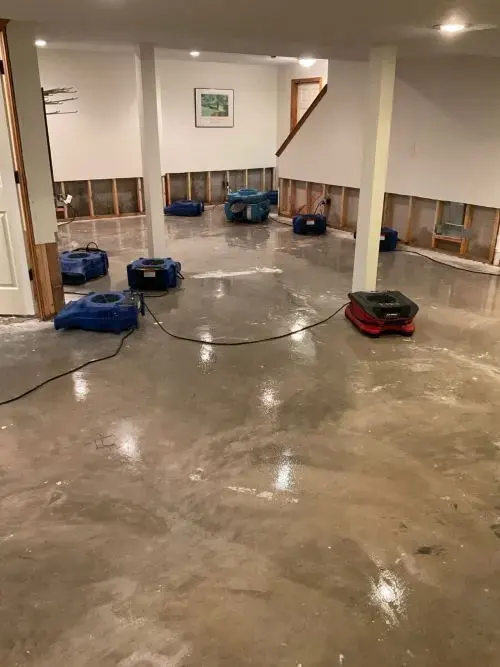
First steps for basement flooding cleanup in Andover
- 1
Find the source
The tech traces the water to runoff, the sump pit, a floor drain or a supply pipe, because each source sets the water category and the handling that follows.
- 2
Pump and extract
Submersible pumps clear deep water at a steady pace, then truck-mounted and weighted extractors lift what is left in carpet, pad and low spots.
- 3
Cut and remove
Soaked pad, carpet and lower drywall come out where readings call for it, and insulation behind each cut is checked and replaced if it is wet.
- 4
Dry to the goal
LGR dehumidifiers and air movers run until slab, bottom plates and studs match a dry reference, with readings logged on every visit.
Basement water in Andover tends to arrive one of three ways: runoff that pools against the foundation, a sump pump that stops, or a floor drain that backs up. Each one leaves a different category of water, so the first job is to find the source, sort the water and start pumping before carpet, pad and drywall wick it upward.
What does basement flooding cleanup cost in Andover, MN?
Most Andover basement jobs run $1,500 to $3,500 when the floor is bare concrete and $3,500 to $8,500 once carpet, pad and lower drywall are involved, while contaminated water starts at $8,500.
Unfinished basement
$1,500 to $3,500
- Bare slab and open walls
- Pump-out, extraction, drying
- Clean or storm water
Finished basement
$3,500 to $8,500
- Carpet, pad and lower drywall
- Flood cuts and structural drying
- Clean or gray water
Contaminated basement
$8,500 and up
- Sewer or creek water
- Containment, full removal
- Antimicrobial, then drying
Ranges are typical, not a quote: the water category, square footage, material class and how fast drying started move the number most. Run the water damage cost calculator for a closer range.
Why Andover basements take on water
Andover's storm drainage runs through storm sewers, catch basins, sediment ponds and ditches, and Anoka County's hazard plan lists flat terrain and overwhelmed storm drains as flood factors.
- Runoff that pools against the foundation after a heavy storm or fast snowmelt
- A sump pump that fails, loses power during the storm or simply cannot keep pace
- A floor drain that backs up when the sewer is overloaded or blocked
- Seepage through cracks in the walls or at the joint between wall and slab
City council workshop minutes from November 22, 2022 record that the Woodland Estates stormwater system was designed before the newer Atlas 14 requirements, for a smaller water standard. Drainage sized for a smaller storm leaves less room when rain is heavy, which is why a wet basement is always traced back to its source.
Pumping out a flooded basement step by step
Deep water goes first, using submersible pumps that clear the floor at a steady pace. If the ground outside is still saturated, the drawdown is paced so the walls are not left holding back soil water with nothing inside. Truck-mounted and weighted extractors then lift what remains in carpet, pad and low spots, and the tech checks the sump pit and floor drains for backflow.
With the water down, the tech sorts the layers. Carpet pad almost always comes out, and finished carpet is cleaned or removed depending on the water category. Lower drywall is cut above the water mark, and wet insulation behind it is replaced. Concrete and framing stay and get dried. Flood cuts follow the readings, not a fixed height, so a dry upper wall is left in place.
Drying the slab, walls and framing
Concrete can hold moisture for days, so the drying team sets LGR dehumidifiers and air movers to pull water out of the slab, the wall bases and the bottom plates. Vapor barrier and insulation are checked because they can trap moisture against the wall. The drying plan comes from the readings, so equipment sits where the wet material is, not where it is easiest to plug in.
Readings are taken every day at the same marked spots, and the equipment is adjusted until the numbers match a dry reference taken from an unaffected part of the home. Only then does the job close. That daily log doubles as the record an adjuster asks for, so nothing has to be reconstructed later.
Rebuilding, permits and the next storm
Andover requires a building permit for work such as basement finishes, so a rebuild that replaces finished walls and flooring may need one. The mitigation team documents the scope; the rebuild is its own step. Crews run the same process for basement flooding cleanup in Anoka and the surrounding cities.
Andover requires a sump pump to discharge outside onto a yard or drainway rather than into a basement drain, laundry tub or straight to the street, so the discharge hose is worth a look before the next storm. The drying time estimator helps plan the days ahead.