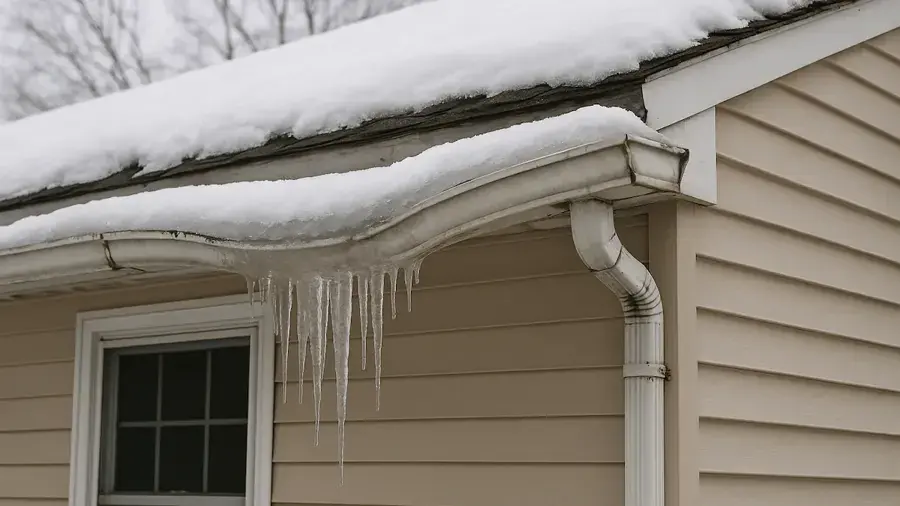
First steps for ice dam and roof leak water damage in Dayton
- 1
Catch the drips
Place buckets under drips, lift furniture away from stained ceilings and cover items that cannot move with plastic sheeting.
- 2
Check the light fixtures
If water is near a ceiling light or an outlet, turn the circuit off at the panel and do not use that fixture.
- 3
Look at the attic
From the hatch, look for dark or compressed insulation and note it, but do not walk on wet insulation or joists.
- 4
Photograph the stains
Photograph ceilings, walls and the roof edge from the ground, then keep damaged materials for the adjuster to see.
An ice dam is a winter roof problem that becomes a water problem inside. Heat escaping into the attic melts snow, the meltwater runs to the cold eave and refreezes, and the ridge of ice forces later meltwater back under the shingles. The mitigation team deals with what that water soaked, from attic insulation to ceilings and wall cavities.
What does ice dam and roof leak water damage cost in Dayton, MN?
Ice dam and roof leak cleanup in Dayton usually runs $1,000 to $2,500 for one ceiling area and $2,500 to $6,500 when attic insulation and several ceilings are wet, with water inside exterior walls starting at $6,500.
One ceiling area
$1,000 to $2,500
- A stain near one outside wall
- Small opening and drying
- Readings kept for the file
Attic and ceilings
$2,500 to $6,500
- Wet insulation removed
- Several ceilings dried
- Upper floor dehumidified
Walls and ceilings
$6,500 and up
- Water inside outside walls
- Drywall and insulation out
- Longer structural drying
Ranges are typical, not a quote: the water category, square footage, material class and how fast drying started move the number most. Run the water damage cost calculator for a closer range.
How an ice dam leaks inside
Once the roof edge is blocked, the water follows a predictable path, and it usually leaves clues in a familiar order.
- Wet or compressed insulation above the exterior walls of the top floor
- Brown stains or bubbling paint on ceilings near outside walls and windows
- Water running down inside the wall cavity and showing up at window trim
- Dripping at a light fixture or a ceiling seam during a thaw
Because the water travels inside the structure, a small stain can sit above a much wetter area. Moisture readings find it before drywall is opened, which keeps the openings small, and a thermal camera helps show the edge of the wet zone.
What gets removed and dried
Wet insulation holds water against the ceiling and does not dry well in place, so it is removed. Ceiling drywall that is sagging, stained through or reading wet is cut back, and exterior wall cavities are opened only where meters call for it. Insulation bags go out first so the rest of the work stays clean.
Air movers and dehumidifiers then dry the upper floor while the attic opening stays accessible for checks. Daily logs track the readings until the framing and drywall match dry reference points. Rooms below the top floor are checked too, since water that runs down a wall can pool in a lower cavity.
Housing in Dayton, new and old
Dayton has 551 homes from the 1970s and 899 built in 2010 or later, plus 1,895 detached single-family homes among 2,200 housing units in the 2018 count. Ice dams can form on a roof of any age wherever heat escapes into the attic, and where the leak shows up depends on the layout, not the year.
The mitigation team does not guess at the roof. It documents where water entered the living space, hands that map to the owner and the roofer, and dries the rooms below. Two trades working from the same map get the repair right the first time.
After the roof is fixed
A roofer repairs shingles, flashing or ventilation, and the drying team schedules around that work so equipment does not run while the roof is open to more water. Insulation is replaced only once the framing reads dry.
Plumbing leaks can follow a similar path, covered under burst pipe water damage, and the readings are logged as described in structural drying. Photos of the stains and the opened ceilings are kept for the claim.