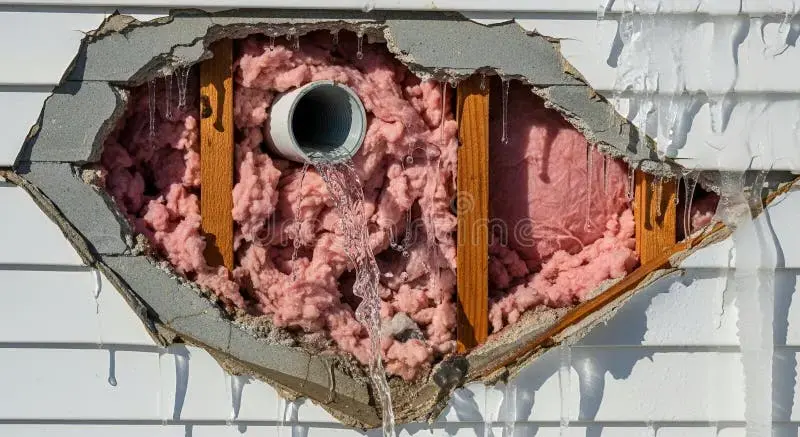
First steps for frozen pipe water damage in Dayton
- 1
Shut off the main
Close the main water valve as soon as a split is found, then open a low faucet to drain what remains in the pipes.
- 2
Keep the heat on
Keep the furnace running and open cabinet doors on outside walls so warm air reaches the pipes while the cause is sorted out.
- 3
Protect the floors below
Move furniture and electronics out from under any ceiling stain and set buckets under drips before drywall sags.
- 4
Photograph before cleanup
Photograph the split, the wet wall and each stain, and keep damaged insulation or drywall until the adjuster has seen it.
Water from a frozen pipe rarely announces itself. The split sits inside a wall or above a ceiling until the thaw lets it run, and by the time a stain appears the cavity may have been wet for hours. Dayton crews trace the break, stop the spread and dry the framing before soaked insulation and drywall stay damp long enough to do lasting harm.
What does frozen pipe water damage cost in Dayton, MN?
Frozen pipe jobs in Dayton usually run $1,200 to $2,800 for one wall or cabinet and $2,800 to $7,000 when water reached a ceiling below, while several split points on separate pipe runs start at $7,000.
One wall or cabinet
$1,200 to $2,800
- One split, found early
- Small opening and extraction
- Cavity drying in place
Wall plus ceiling below
$2,800 to $7,000
- Water ran through two levels
- Ceiling drywall and insulation removed
- Drying on both floors
Several split points
$7,000 and up
- Splits on more than one pipe run
- Finished basement soaked too
- Larger tear-out and longer drying
Ranges are typical, not a quote: the water category, square footage, material class and how fast drying started move the number most. Run the water damage cost calculator for a closer range.
Where Dayton pipes split in winter
Outside walls, unheated garages and crawl spaces are the usual trouble spots, because the pipes there sit right up against the cold.
- Supply pipes inside an outside wall, behind a sink or tub on the exterior side
- Pipes in an attached garage, where an open door can drop the temperature quickly
- Runs through a crawl space or an unheated mechanical area
- Short stubs feeding an outdoor spigot or a laundry connection
The break usually happens during the cold snap but leaks once the ice melts, so the first sign is often a drip in a ceiling, a damp baseboard or a sudden dip in water pressure. A finished basement ceiling under an outside wall is a common place for the first stain to show.
What the city's winter rules reveal
Dayton's own sump rules treat winter as a hazard: from November 15 to March 15 the city may permit sump discharge into the sanitary sewer when frozen discharge would create dangerous ice. It is a reminder that cold changes how water behaves around buildings, indoors and out.
Homes of every age are exposed. City housing figures list 175 homes built in 1949 or earlier and 899 built in 2010 or later, and an exposed pipe in a cold corner can split in either one. The mitigation team treats each break as its own puzzle, whether it sits in the Historic Village, the city's oldest permanent development, or in the newest subdivision.
From the first drip to a dry wall
Once the water is shut off, the team extracts what pooled, then follows the wet path with moisture meters and a thermal camera. Insulation soaked by the break comes out, drywall is opened only as far as readings demand, and ceilings below are checked because water runs down before it spreads out. Wet insulation is bagged out of the cavity instead of being left to dry, since it holds water against the framing.
If water ran through to a finished basement or a room underneath, those surfaces are opened and dried as well, which is how a single split pipe becomes burst pipe water damage across two floors.
Thaw safely, then dry
Shut the main water valve, open cabinet doors on outside walls and keep the heat on while waiting. Leaving a tap at a slow drip during a hard cold snap keeps water moving. Never put an open flame to a pipe, and leave the repair itself to a plumber.
After the repair, the drying team returns to confirm readings, document the cavity for the claim and take down the equipment. The equipment side is covered in structural drying.