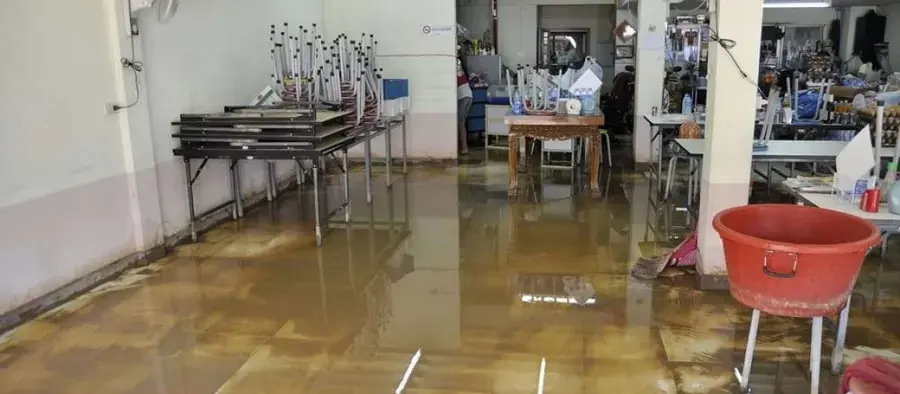
First steps for commercial water damage in Dayton
- 1
Stop the water
Close the source valve or have maintenance do it, and note the time and cause for the record.
- 2
Protect inventory and data
Move stock, electronics and paper records off the floor and out of the wet area, and cover what cannot move.
- 3
Alert the property manager
Tell the property manager and any neighboring tenants so shared walls and ceilings can be checked.
- 4
Photograph before cleanup
Photograph the source, the wet areas and damaged stock before anything is moved or thrown out.
For a business, water damage is a clock as well as a mess. Every day a storefront or suite stays wet costs revenue, so the response team works around business hours, isolates the wet space and dries it in phases while neighboring suites keep operating where conditions allow.
What does commercial water damage cost in Dayton, MN?
Commercial water damage in Dayton usually runs $3,000 to $8,000 for one suite or storefront and $8,000 to $25,000 for several suites or a floor, with large or contaminated losses starting at $25,000 and rising from there.
Single suite or storefront
$3,000 to $8,000
- One space, clean water
- Extraction, then drying
- Scheduled around business hours
Several suites or a floor
$8,000 to $25,000
- Water crossed shared walls
- Phased drying by space
- Documentation for each tenant
Large or contaminated
$25,000 and up
- Backup or multi-floor loss
- Containment and removal
- Extended drying
Ranges are typical, not a quote: the water category, square footage, material class and how fast drying started move the number most. Run the water damage cost calculator for a closer range.
Dayton's business base
The city's 2040 plan names ADESA Auto Auction, King Solutions, ICA Corporation and Dayton Elementary School in the Anoka-Hennepin School District among its major employers.
- An industrial park in Southwest Dayton, which the 2040 plan lists among the areas on city water
- Commercial and industrial land along Highway 169 and I-94
- The Historic Village, where low density homes and businesses sit side by side
The city also lists the Graco headquarters on West French Lake Road, a Carvana on Territorial Road and Suite Living at Dayton River Road and Balsam Lane as commercial projects under construction. New buildings mean new tenants, and the same water problems follow.
Phased drying keeps tenants working
Drying a multi-tenant building one space at a time lets the crew set equipment where water traveled and leave unaffected suites alone. Moisture mapping follows shared walls and ceilings so water that crossed a wall between suites is found, not assumed.
Containment keeps dust and noise from drifting into occupied areas, and equipment is placed to leave exits, counters and loading areas clear.
Records for owners and tenants
Property managers need documentation that separates one tenant's space from the next. The team keeps photos, moisture maps and drying logs per space, so each tenant, the owner and the insurers can see their own part of the loss.
Large losses, including a sewage backup or a multi-floor leak, are staged with containment and removal first, as described in sewage backup cleanup.
Getting back to business
Drying ends when readings match dry reference points, and equipment comes out in the order that frees space for the business soonest.
Equipment and process details are covered in structural drying, and each suite's file closes when its readings do.