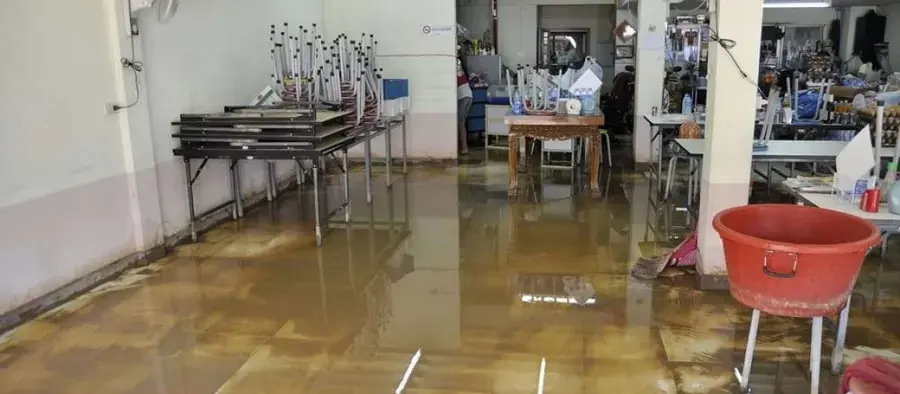
First steps for commercial water damage in Champlin
- 1
Secure the space
Shut off the water source and the power to wet areas, and keep customers and staff out of the affected rooms.
- 2
Protect inventory and records
Move stock, files and electronics to dry rooms and shelves, and cover what cannot be moved with plastic.
- 3
Tell the building owner
Notify the landlord, property manager or association so neighboring suites and shared walls can be checked.
- 4
Document the loss
Photograph damage and inventory, keep receipts, and note the time the water was found before cleanup begins.
A commercial water loss is a schedule problem as much as a moisture problem. Tenants need to reopen, landlords need to protect shared walls and floors, and every party needs its own records. The commercial team plans the dry-out around the building, not just the water.
What does commercial water damage cost in Champlin, MN?
Commercial water damage in Champlin usually costs $3,000 to $8,000 for one suite or storefront, $8,000 to $25,000 for several suites or a floor, and $25,000 and up for large or contaminated losses.
One suite or shop
$3,000 to $8,000
- A single space, clean water
- Extraction and drying
- Scheduled around opening hours
Several suites or a floor
$8,000 to $25,000
- Water crossed shared walls
- Drying phased by space
- Records kept for each tenant
Large or contaminated
$25,000 and up
- Sewage or multi floor loss
- Containment and removal
- Extended drying runs
Ranges are typical, not a quote: the water category, square footage, material class and how fast drying started move the number most. Run the water damage cost calculator for a closer range.
Highway 169 and Champlin's commercial land
The largest concentration of Champlin's commercial, office and industrial land runs along Highway 169, and those uses together cover about six percent of the city's land. Elm Creek Commons is a 39-acre commercial and retail development west of the highway.
- Storefronts and offices that share walls with neighbors
- Event spaces with large open floors
- Apartment buildings and senior housing with common areas
- Retail centers with many tenants under one roof
Each kind of space fails differently. A sprinkler head in a retail row can wet several suites at once, while a failed supply pipe in an apartment building usually drops water onto the unit below.
Keeping a business open during drying
The team sets up containment to keep wet areas separate from the working ones, and runs equipment in phases so one space is released while the next is still drying.
Noise and cords are planned around opening hours, and after-hours scheduling lets a shop, clinic or office keep serving customers in the dry part of the building.
Shared walls and documentation
Water that crosses a shared wall belongs to more than one claim. Photos, moisture readings and drying logs are recorded for each tenant and for the common areas, so the landlord, each tenant and each insurer see their own part of the loss.
In a multi-unit building, such as the older apartment developments inside Mississippi Crossings, the same approach protects both residents and owners.
Large losses and contaminated water
A sewage backup or a multi-floor loss needs containment, removal of porous materials and a longer drying run, following the contaminated-water steps used for sewage backup cleanup in Champlin.
Equipment is sized to the building volume, and the logs from Champlin structural drying show tenants when each space is dry enough to reopen.