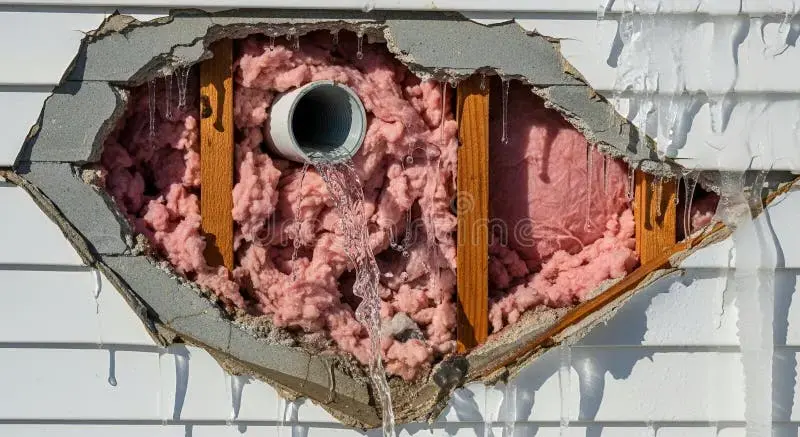
First steps for frozen pipe water damage in Andover
- 1
Stop the water
The main valve is closed, faucets are opened to drain the pipes, and the tech locates the split so the repair can begin and the spread can be measured.
- 2
Extract and open up
Standing water is extracted, then wet insulation and the lowest section of soaked drywall are removed so each cavity can be reached and dried.
- 3
Trace the route
A moisture meter and thermal camera follow the water along framing, pipes and ceilings, since it often travels far beyond the split itself.
- 4
Dry and document
Air movers, dehumidifiers and cavity ports run until each material reaches its dry goal, and photos and daily readings go into the claim file.
Ice does not leak, so a frozen pipe usually looks fine until the weather warms and the ice melts. Then a split that was holding back pressure lets go, and water runs inside the wall, down to the ceiling below or across the floor. The first job is to stop the water, then find every wet layer.
What does frozen pipe water damage cost in Andover, MN?
A freeze that opens one wall or cabinet usually runs $1,200 to $2,800, water that also reached the ceiling below runs $2,800 to $7,000, and several split pipes or a soaked finished basement start at $7,000.
One wall or cabinet
$1,200 to $2,800
- A single split, caught early
- Small opening in the wall or cabinet
- Extraction and cavity drying
Wall and ceiling below
$2,800 to $7,000
- Water crossed two levels
- Ceiling drywall and insulation removed
- Drying on both floors
Several freeze points
$7,000 and up
- Splits on more than one pipe
- Finished basement is soaked too
- Wider tear-out and longer drying
Ranges are typical, not a quote: the water category, square footage, material class and how fast drying started move the number most. Run the water damage cost calculator for a closer range.
Where freeze damage hides
Minnesota winter cold can freeze pipes in outside walls, garages, cabinets on exterior walls and other unheated spaces. Pipes with thin insulation or a run through a garage ceiling are the usual casualties. The split is often a thin crack that sprays inside the wall long before anyone sees it.
- Stains or sagging on a ceiling below a bathroom or kitchen
- Damp, soft or discolored drywall on an outside wall
- The sound of running water when every fixture is off
- A sudden drop in water pressure at one faucet or room
A thermal camera and moisture meter trace the route the water took, because it often travels along framing and pipes far past the split. That map decides where drywall and insulation are opened.
What happens after the split is found
A plumber repairs the pipe, and the restoration team handles the water. Standing water is extracted first, then wet insulation and the lowest sections of soaked drywall are removed so the cavity can dry. Ceilings that hold water are opened carefully, since a sagging ceiling can drop all at once.
When water reached the basement ceiling or the floor below, the job is treated as a two-level loss, and both floors are mapped and dried together. If the freeze also took out a water heater or water softener, its replacement needs an Andover plumbing permit, and that step runs on the plumber's schedule. Drying does not have to wait for it.
Drying the walls and floors
Air movers push warm, dry air across wet framing, LGR dehumidifiers pull the moisture out of the room, and small injection ports dry the closed cavities behind finished walls. The setup follows the readings, and it is changed whenever the readings change.
Wet wall and ceiling materials left in place can start growing mold in 24 to 48 hours, which is why airflow starts before the repair work is scheduled. Daily logs show when each surface reaches its dry goal, and the log becomes part of the claim file.
Preventing a second freeze
Closed cabinet doors, insulated pipes in unheated spaces and a steady indoor temperature during cold snaps lower the odds of a repeat. The water damage cost calculator shows what a loss like this runs.
A burst that looks small can still have soaked a ceiling and the basement below, so the full picture comes from readings, not from the size of the visible stain. See burst pipe water damage in Andover for the pressure side of the story.