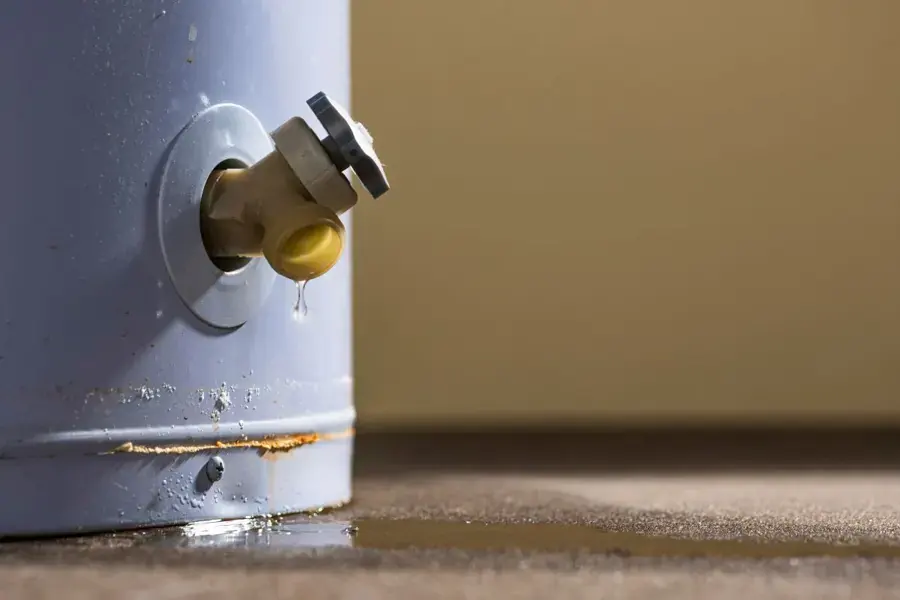
When Ramsey opened a new water treatment plant in Spring 2026, the city told residents to flush their water heaters because sediment collects in them. A flush is maintenance and a leak is damage, but the two can look alike at first.
Key takeaways
- Ramsey's new treatment plant opened in Spring 2026, and the city told residents to limit hot water use and flush water heaters because sediment collects in them.
- A flush clears sediment. It does not fix a tank that leaks, and water at the base or seams of a tank means replacement, not repair.
- Ramsey's list of work that needs a city permit includes water heaters and water softeners, so a replacement should be planned with a permit.
- Shut off the cold water supply to the tank and the power or gas first, then get the water off the floor before it reaches walls and flooring.
- Clean water from a failed tank still becomes a larger problem if it sits, so extraction comes first and drying follows with readings.
What the city told Ramsey residents in Spring 2026
The City of Ramsey opened a new water treatment plant in Spring 2026 to remove iron and manganese from municipal drinking water. When the plant began operating, old deposits in the water mains briefly caused reddish, brown or black water.
The municipal system has about 5,800 service connections and draws from eight deep wells in the Ironton-Galesville aquifer, so the city's advice was aimed at a large number of homes.
The city told residents to limit hot water use until cold water runs clear, and to flush their water heaters, which can collect sediment.
That advice is about sediment. It is a maintenance step, which is why a leak needs its own response.
- Limit hot water: hold back on hot water use until the cold water runs clear.
- Flush the heater: sediment settles at the bottom of a tank and can be drained out.
Flushing versus leaking: telling the two apart
Sediment and leaks both appear in the utility room, but they point in different directions.
A drip from a fitting or a valve can sometimes be repaired. Water coming through the tank itself cannot, so the tank is replaced.
Signs a tank needs flushing
- Rumbling or popping: sediment at the bottom of the tank makes noise as it heats.
- Discolored hot water: reddish or brown hot water can come from deposits.
- Less hot water: a tank packed with sediment holds less heated water.
Signs of a leak
- Water at the base: a puddle or a damp ring around the bottom of the tank.
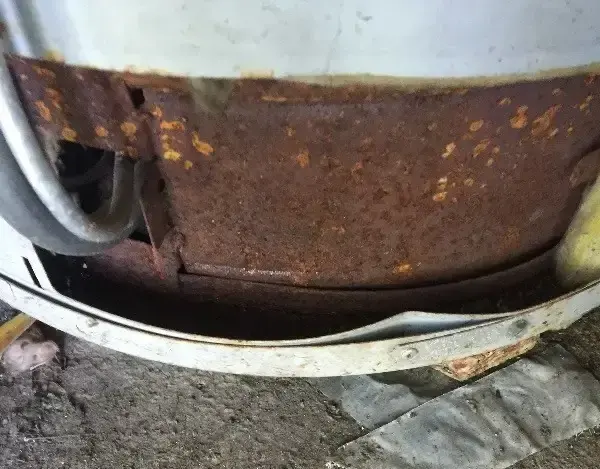
- Rust streaks: stains running down the sides or along the seams.
- Wet fittings: dripping at the supply or outlet connections, or at the relief valve.
- Damp walls or floor: wet drywall, swollen baseboard or a musty smell near the heater.
Why tanks fail
- Corrosion: the steel wall rusts through from the inside once the lining and the anode rod wear out.
- Sediment: a layer at the bottom traps heat and stresses the floor of the tank.
- Pressure: a stuck relief valve or excess pressure strains the seams.
- Age: an old tank is more likely to fail than a newer one, often with little warning.
Where the water goes when a tank fails
A tank in a basement utility room sends water across the slab and into anything stored on it. A tank in a closet or a main floor utility room sends water into flooring and the walls around it.
Many utility rooms hold more than a heater. A furnace, a water softener or a washer can sit within reach of the same puddle, which is why the first look checks what else got wet.
Ramsey has an estimated 7,978 detached homes and 1,929 attached homes such as townhomes. In an attached home, a leak from a tank on an upper level or against a shared wall can reach the neighbor.
A flooded utility room is a job for water damage restoration in Ramsey as soon as the supply is shut off.
- Basement: water spreads across the slab and soaks boxes, drywall and the bottom of the walls.
- Closet or utility room: water gets under flooring and into wall cavities.
- Attached homes: water can pass into a shared wall or the unit below.
The permit for replacing a tank
Ramsey's list of work that needs a city permit includes plumbing alterations, water heaters, water softeners, sewer and water work, vacuum breakers, basement finishing, roof replacement and replacement windows.
A leaking tank is replaced, so the permit is part of the job. Anyone hiring an installer can ask who is pulling it before the old tank comes out.
If a gutted basement is rebuilt afterward, basement finishing is on the same list, so the city can say whether the rebuild needs a permit of its own.
Water softeners are on the same list, so a leaking softener brine tank or a failed softener carries the same question about a permit.
Extraction and drying after a tank leak
Water from a failed tank starts as clean supply water. Left on a floor for a day or two, it picks up contamination from materials and soil, and the job gets larger.
The drying team takes moisture readings on the framing, the subfloor and the slab before and after, so the end of the job is a number and not a guess.
A water heater leak cleanup in Ramsey begins with the supply shut off, followed by water extraction in Ramsey before the water reaches flooring and drywall.
- Shut off: close the cold water valve above the tank and cut the power or gas.
- Extract: pump or wand the water off the slab, carpet or subfloor.
- Open: remove baseboard and cut small openings in walls where readings stay high.
- Remove: take out pad, insulation and drywall that cannot dry in time.
- Dry: run air movers and dehumidifiers until readings match a dry reference.
Keeping the next tank from flooding a floor
A tank gives warnings before it fails if someone checks it. The same steps apply anywhere, including water heater leak cleanup in Anoka.
- Flush as the city suggested: ask a plumber to show how to drain sediment from the tank.
- Look at the base: rust, moisture or a damp pan are early signs of trouble.
- Check the relief valve pipe: it should end where water can drain safely.
- Know the valves: find the cold water shutoff above the tank and the main shutoff.
- Plan the replacement: an old tank with rust at the base is easier to replace on a schedule than in an emergency.
Questions
Should a Ramsey homeowner flush a water heater?
The city told residents to flush their heaters after the plant started up because sediment collects in them. A plumber can show the right way to do it on a specific tank, and a tank that already leaks should be replaced, not flushed.
Is rust colored hot water the same as a leak?
No. Discolored water points to sediment or deposits. A leak appears as water outside the tank or around its fittings.
Does Ramsey require a permit for a new water heater?
Yes. Water heaters are on the city's list of work that needs a city permit, along with water softeners and plumbing alterations.
Can a leaking tank be repaired?
A drip from a valve or a fitting may be repairable. Water coming through the tank wall or seams means the tank has failed and needs replacement.
How long does a floor take to dry after a water heater leak?
Removal and extraction come first. Drying then takes several days in most cases, and moisture readings decide when it is finished.
Do the city's flush instructions apply to a leaking tank?
No. Flushing is for sediment. A tank that leaks should have its supply shut off and then be replaced.