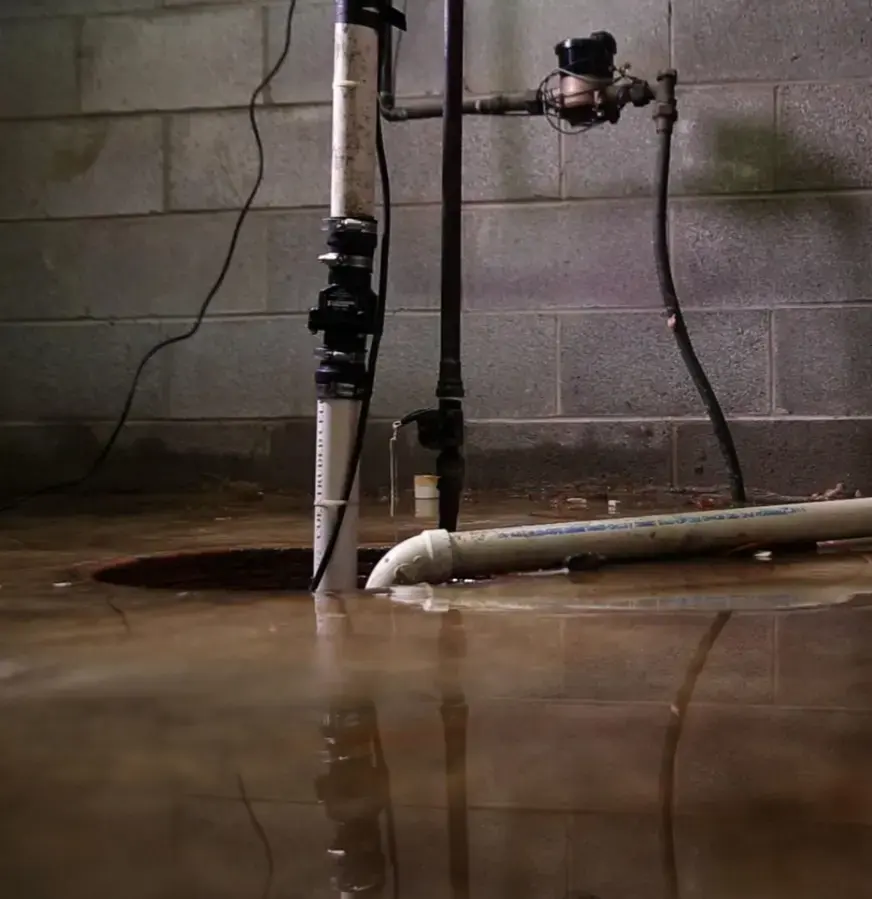
Dayton, Minnesota, is blunt in its city code about sump pump water: it does not belong in the sanitary sewer. The same rules matter most at the worst moment for a homeowner, when a pump stops and the basement starts to fill.
Key takeaways
- Dayton city code bars roof, surface, sump pump and footing tile water from the sanitary sewer.
- Homes with sump pumps permitted after January 1, 2009 must pipe the discharge outside before a certificate of occupancy is issued.
- The city may permit sump discharge into the sanitary sewer from November 15 to March 15, when frozen discharge creates dangerous ice.
- Poorly drained low spots are common in Dayton soils, so water has few easy places to go when a sump pit overflows.
- A failed pump floods fast. Extraction comes first, then wet carpet, pad and lower drywall come out and the slab and framing are dried.
What Dayton's code says about sump pump water
City code bars roof, surface, sump pump, footing tile, swimming pool, spa and hot tub water from the sanitary sewer.
The sump ordinance applies to buildings that need a sump pump discharge system because water infiltrates basements, crawl spaces and similar spaces.
New dwellings with sump pumps permitted after January 1, 2009 must pipe the sump discharge to the outside before a certificate of occupancy is issued.
That requirement is written for homes permitted after that date, so older houses can differ in how and where the pump discharges. The ban on sump water in the sanitary sewer is stated for the city as a whole.
Dayton's homes span several eras: 899 of 2,480 were built in 2010 or later, 551 date from the 1970s and 175 from 1949 or earlier. Pumps get replaced over the life of a house, so the age of the home says little about the age of the pump, and an older pump deserves a test before heavy rain.
- Not allowed in the sanitary sewer: roof, surface, sump pump, footing tile, pool, spa and hot tub water.
- Required outside: discharge piped outdoors for homes with sump pumps permitted after January 1, 2009.
- Winter exception: the city may permit sump discharge into the sanitary sewer from November 15 to March 15 when frozen discharge creates dangerous ice.
Why the rule exists
Clear water in a sanitary sewer takes up room meant for wastewater. The city's sewer plan lists sump pump connections that do not comply with the code, leaky pipes under groundwater or flooded conditions, service pipe leaks and floor drains of flooded buildings as possible sources of that extra water.
Dayton's sanitary system uses 10 lift stations, force mains and gravity pipe, and treatment is handled by Otsego and the Metropolitan Council. Extra clear water adds load to all of it.
The winter exception, November 15 to March 15
Frozen discharge pipes are a real winter problem. When water leaves the house through an outside pipe and freezes on the ground, it can build a dangerous sheet of ice.
For that reason the city may permit sump discharge into the sanitary sewer from November 15 to March 15. The wording says may, so it is a question for the city and not a permission to assume.
The rest of the year, the water goes outside.
How a sump pump fails
Most failures come from a short list of causes, and several of them occur together during a storm. Poorly drained low spots with wetland plants are common in Dayton, so a pit that stops working has little room for error.
Power and mechanics
- Power outage: storms that flood basements often cut power too, and a pump without backup stops.
- Stuck float: a float switch that jams leaves the pump idle while the pit overflows.
- Worn pump: an old motor can run hot, hum or cycle constantly before it quits.
The discharge side
- Blocked pipe: a crushed, clogged or kinked discharge pipe has nowhere to send water.
- Frozen outlet: ice at the outside end holds water back inside the pipe.
- Short run: discharge that ends beside the foundation can soak back toward the wall.
Warning signs before a failure
- Constant running: a pump that cycles all day in dry weather is working too hard.
- Silence in a full pit: a pump that never starts while the water rises needs attention at once.
- Noise and smell: grinding, rattling or a hot motor smell point to a worn pump.
- A crooked float: a float that leans or rubs the side of the pit can stick.
An overwhelmed pit
Even a healthy pump can be outrun when groundwater and runoff come together. That is the situation a sump pump failure cleanup in Dayton is built for.

What a flooded Dayton basement needs first
When a pit overflows, water spreads across the slab and into whatever sits on it. Ground water and pit water are usually treated as contaminated, Category 2 or Category 3, so porous materials are removed rather than saved.
A full basement flooding cleanup in Dayton follows a set order, because each step protects the next one.
Hard surfaces such as sealed concrete can usually be cleaned and kept. Carpet pad, insulation and drywall that stood in the water are the usual removals.
- Extraction: standing water comes out first.
- Removal: wet carpet, pad, lower drywall and baseboard.
- Cleaning: surfaces that stay are cleaned and disinfected.
- Drying: air movers and dehumidifiers run until the slab and framing read dry.
- Repair: the pump, the discharge pipe and the finishes are replaced once readings are dry.
Checks before the next heavy rain
A short check of the pit now beats a flooded floor later. Anyone in Dayton with a pump can run through the same list.
Homeowners who want help with an overflow or a failed pump can start with Dayton water damage restoration or the wider sump pump failure cleanup in Anoka.
- Lift test: pour water into the pit and watch the pump start and stop.
- Discharge: follow the outside pipe and clear leaves, ice and crushed sections.
- Backup power: consider a battery backup so a storm outage does not stop the pump.
- Records: photograph the pit and pump so changes are easy to spot.
- Ask the city: confirm the winter discharge exception before relying on it.
Low spots, five watersheds and the 2018 water plan
Dayton's plan divides the city into five watersheds: Crow River, Diamond Creek, Elm Creek, Mississippi River and Rush Creek. The city also has 8 lakes, including Diamond Lake, French Lake, Dubay Lake and Laura Lake.
The city's water management plan, completed in October 2018, recommends overflow routes for extreme storms and final high water levels for buildings next to ponding areas and floodplains.
- Overflow routes: a planned path for water when a storm outruns the pond or the pipe.
- High water levels: a set elevation that a building next to a ponding area should sit above.
- Low spots: the places where water stands longest are the places where pits work hardest.
Questions
Can sump pump water go into the sanitary sewer in Dayton?
City code bars it. The city may permit it from November 15 to March 15 when frozen discharge creates dangerous ice, so the city should be asked first.
Where should a Dayton sump pump discharge?
Outside. Homes with sump pumps permitted after January 1, 2009 must pipe the discharge outdoors before a certificate of occupancy is issued, and the code bars sump water from the sanitary sewer.
What does a basement look like after a sump pump quits?
Water spreads across the slab, wets carpet, pad, stored boxes and the bottom of the walls, and keeps wicking upward until it is extracted.
Does a battery backup solve the problem?
It helps when the power fails. It does not help with a stuck float, a worn pump or a blocked or frozen discharge pipe.
How long does a wet basement take to dry?
Drying usually takes several days after extraction and removal, with moisture readings taken until the slab and framing are dry.
What triggers the sump ordinance in Dayton?
The ordinance applies to buildings that need a sump pump discharge system because water infiltrates basements, crawl spaces and similar spaces. Roof, surface and footing tile water are barred from the sanitary sewer as well.